
Not Just for Appearance's Sake: Curriculum and Textbooks Synchronized, UIN Jakarta Tightens Publication Quality
- 25 February 2026
- 4 min read
- 769
-

-

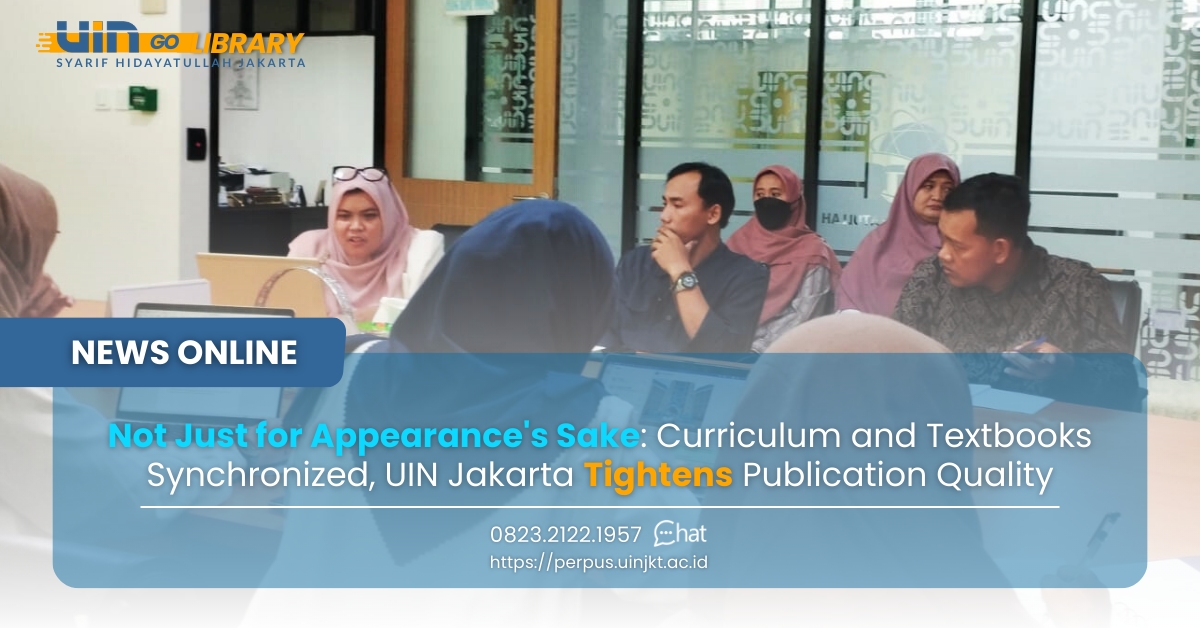
UIN Jakarta Library Building, News Online — Syarif Hidayatullah State Islamic University (UIN) Jakarta has begun serious reforms in the development of textbooks and academic publication systems. Through a discussion held on Tuesday (February 24, 2026), the campus reaffirmed its commitment to synchronizing the curriculum and textbooks while tightening the quality standards for scientific publications.
The discussion, themed “Strengthening the Development of Curriculum-Based Textbooks and Improving the Quality of Academic Publications,” was initiated by the Head of the UIN Jakarta Library, Agus Rifai. In his official invitation, Agus presented the Head of the UIN Jakarta Learning and Curriculum Development Center, Ramdhani Miftah, as well as a team from RajaGrafindo Publishing —Ardi. Meanwhile, from the UIN Jakarta Publishing Team, Ulpah Andyani, Iif Fikriyati, Lina Farida, Lismawarni Dewi, Imas Fathonah, and Rizki Mulyarahman were also present.
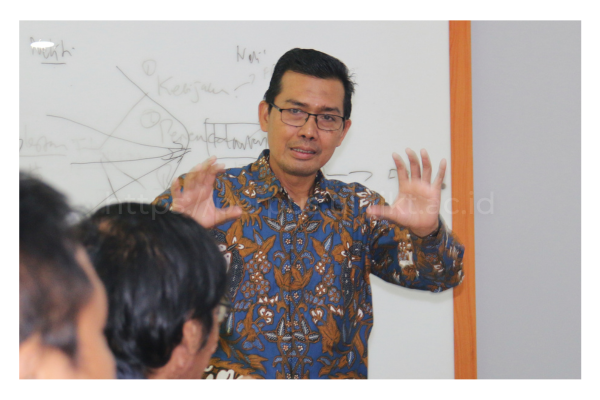 The discussion was dynamic. Agus Rifai openly highlighted the practice of compiling textbooks that were not fully integrated with curriculum design. Textbooks, according to him, should be a direct derivative of the curriculum and be in line with graduate learning outcomes (CPL).
“If the curriculum talks about graduate learning outcomes (CPL), but the textbooks are not derived from that, then what happens is academic inconsistency,” said Agus Rifai.
Furthermore, according to him, textbooks should no longer be viewed as administrative products to fulfill lecturers' workloads or accreditation requirements alone. Instead, textbooks should be a direct derivative of the curriculum and lecturers' research.
Publication Quality Tightened
In addition to discussing content synchronization, the discussion also highlighted the importance of improving the quality of academic publications. Methodology, novelty of ideas, accuracy of citations, and professional editorial processes were the focus of the discussion.
Meanwhile, the involvement of RajaGrafindo Publishing shows that improving the quality of publications cannot be separated from professional publishing industry standards. The editorial process, content review, layout, and distribution are important parts of ensuring that textbooks are not only readable but also suitable for reference. This step also ensures that published textbooks meet professional publishing standards and have clear distribution channels.
In addition, this discussion also opened up opportunities for the development of a mentoring scheme for lecturers in writing curriculum-based textbooks, including strengthening aspects of methodology, novelty of ideas, and compliance with academic ethics.
The Curriculum as an Academic Roadmap
Ramdhani Miftah emphasized that the curriculum is not merely a formal document, but rather an academic roadmap. “The curriculum is an academic roadmap. Textbooks must be instruments to ensure that the roadmap is actually implemented in classrooms,” said Ramdhani.
Ramdhani Miftah added that the curriculum is a document that contains scientific directions and graduate profiles. Therefore, every textbook should ideally be derived directly from curriculum requirements. For this reason, this forum encourages a collaborative model between curriculum managers, libraries, and publishers to create a more controlled and measurable academic ecosystem.
The discussion also opened up discourse on the formation of a scheme for assisting in the writing of curriculum-based textbooks, including the affirmation of academic ethical standards and quality control of content.
Maintain Academic Reputation
This step of synchronizing the curriculum and textbooks is part of the effort to maintain the academic reputation of UIN Jakarta as a state religious university that is adaptive to change, while still adhering to scientific integrity.
With these improvements, UIN Jakarta hopes that every textbook used by students will be truly relevant to the curriculum, have strong scientific standards, and support the continuous improvement of academic publications. For the university, the issue is not simply a matter of publishing books. What is at stake is the consistency of the academic system itself.
Ultimately, this effort confirms one thing: in academic matters, there is no room for carelessness.
(Contributor: Rizki Mulyarahman; Design & Documentation: Rizki Mulyarahman; Editors: Agus Rifai/Rizki Mulyarahman)
For news updates and further information, please visit:




